


Meta descriptions are a familiar part of Search Engine Optimisation (SEO). They give a short summary of a page’s content, so the searcher knows what to expect before they click. Most SEO advice tells you to spend time writing a good one for every page. But there has been a long-running debate about whether meta descriptions directly affect a page’s search rankings.
In this article, we’ll answer the question “Are meta descriptions a ranking factor?”, look at what Google actually does with them, and explain why they’re still worth writing.
What is a meta description?
A meta description is a short snippet describing a web page’s content. Its job is to give search engine users a preview of what they’ll find if they click. Technically, it’s an HTML tag in the page’s <head>:
<meta name="description" content="A short summary of what this page is about.">
Search engines can use it as the grey text under your page title in the results (the “snippet”). The idea is to summarise the page in a concise and compelling way that encourages the click.

If a user has two results to choose from, one with a boring, generic description and one that’s clearly been written with care and leaves them wanting more, which one would they choose?
Google’s official stance on meta descriptions and ranking
Google has been unusually clear on this one, for a long time.
Back in September 2009, Google’s Matt Cutts wrote on the Search Central blog that “even though we sometimes use the description meta tag for the snippets we show, we still don’t use the description meta tag in our ranking.”
John Mueller, Google’s Search Advocate and the closest thing Google has to a spokesperson for search, has repeated it many times since, including in a 2020 tweet and on the Google Search Central YouTube channel (here, at 26:57).
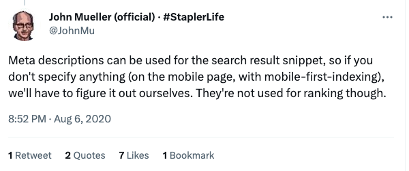
So the official answer is: meta descriptions are not a ranking factor for Google. If you’re reading this in disbelief after spending hours crafting the perfect description for every page on your site, hold that thought, because there’s more to it.
Does Google even show your meta description?
Here’s the part that surprises people. Google’s own documentation says that snippets are “primarily created from the page content itself”, and that it uses your meta description when it “might give users a more accurate description” than the page text would. Snippets are also tailored to each search, so the same page can show different snippets for different queries.
In practice, Google rewrites a lot of them. When Ahrefs studied 20,000 keywords in 2020, Google ignored the hard-coded meta description and wrote its own 62.78% of the time, more often for long-tail searches than for broad ones. A quarter of top-ranking pages had no meta description at all.
So your description is a suggestion to Google, not an instruction. It’s most likely to be used when it genuinely describes the whole page and matches what people are searching for.
What’s the point of meta descriptions, then?
If they aren’t a ranking factor and Google rewrites most of them, should we just forget about them… right?
No. Meta descriptions don’t affect where you rank, but they affect whether people click once you’re there. A well-written description can noticeably increase the click-through rate (CTR) of your organic result. The ranking position is the same; the traffic isn’t.
Simply put, a good description gets a higher percentage of the people who see your result to visit your site. If those visitors find what the description promised and stick around, that’s a better outcome for them and for you, regardless of what Google’s algorithm thinks of the tag itself.
There’s a second benefit: the description sets expectations. An accurate one brings the right people and keeps away the wrong ones, which means less wasted traffic and fewer people bouncing straight back to the results.
How to write one that earns the click
Google’s own guidance for descriptions is short, and it’s the best place to start:
- Write a unique description for every page. Duplicated or boilerplate descriptions are the ones Google is most likely to replace. If you can’t do every page, do the important ones first.
- Describe the whole page, specifically. Include the facts the searcher wants: what the page offers, who it’s for, a price or a date if that’s relevant. Vague descriptions get rewritten.
- Don’t write a list of keywords. Google says keyword lists don’t describe the page and are less likely to be shown.
- Match the search. Think about what someone types to find the page and answer that in the first few words.
- Keep it readable. There’s no official length limit, but Google cuts snippets to fit the screen, so around 150 characters is a sensible working limit if you want the whole thing to show. Front-load the important part.
- Give a reason to click. A benefit, a number, a question answered. Not clickbait; the page has to deliver.
Then check your work. Search Console’s Performance report shows pages with plenty of impressions and a low click rate; those are the descriptions to rewrite first. If Google keeps replacing yours, read the snippet it chose and ask why its version describes the page better than yours.
Now you know
Meta descriptions don’t affect your rankings, and Google says so plainly. But they do affect how many of the people who see your result choose to click it, and that’s traffic you’d otherwise be leaving on the page.
Writing a clear, specific description for each page remains a worthwhile habit. If you’d like help with your site’s SEO, from titles and descriptions to the bigger picture, get in touch.